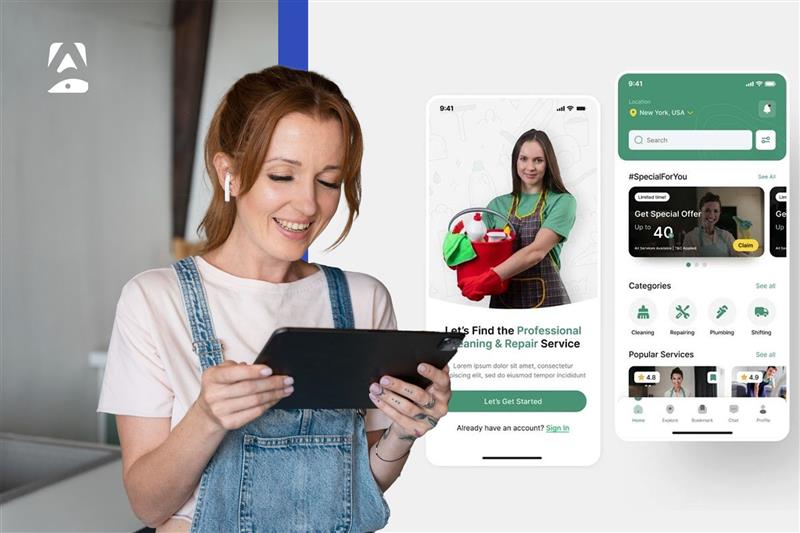
A Dubai-based startup once launched a home services app with great expectations. Downloads were decent, but within weeks, user activity dropped. The problem wasn’t demand it was the execution. Users in the UAE demand quick booking, reliable providers, and a hassle-free experience. When your app lacks any of these, they leave.
That is why On Demand Home Services App Development nowadays is not only about developing an app but a full ecosystem that will unite users, service providers, and operations.
This blog will teach you how to create, grow, and monetize a home services app including features, cost, tech stack, monetization, and real-life strategies.
What is On Demand Home Services App Development?
On-Demand Home Services App Development is the development of online platforms that allow users to request services like cleaning, plumbing, electrical, maintenance, etc., in real-time through mobile apps. These are two-sided markets:
- Users book services in real time
- Service providers accept and complete jobs
- Payments, tracking, and reviews are handled within the app
Applications such as Gojek demonstrate how these platforms can be expanded to a variety of services without losing their convenience and efficiency.
Top Apps Like Gojek & Market Overview
It is necessary to know the competitive environment before developing your app.
Popular Apps in this Space.
These apps succeed because they:
- Offer multiple services in one platform
- Maintain strong provider networks
- Focus heavily on user experience
For any home services app development company, studying these platforms helps in building competitive and scalable solutions.
Why On-Demand Home Services Apps Are Growing in the UAE
The UAE is a robust market to develop on demand home services app due to the changing user behavior and high digital adoption. The following are the main factors that are fueling this growth:
-
High Smartphone Usage
Most people in the UAE use smartphones daily for services like food delivery and transport. This makes it easier for users to adopt On-Demand Service Provider Applications for home services as well.
-
Busy Urban Lifestyles
In cities like Dubai, people prefer quick solutions. Instead of calling multiple vendors, they can book a service in seconds through an app.
-
Demand for Convenience
Users desire it all to be quick and easy, booking, tracking and payments under a single roof. This is one of the reasons why on-demand app development services are rapidly increasing.
-
Trust and Transparency
Apps provide verified professionals, ratings, and clear pricing. This builds trust compared to hiring unknown local service providers.
Statista (2024) indicates that the home services market is projected to be over 1.2 trillion by 2027, which demonstrates the high demand in the future. For any mobile app development company in Dubai, this creates long-term opportunities to build scalable and profitable platforms.
On-Demand Home Services App Development: Step-by-Step Process
Building a successful app requires a clear and structured strategy. Find out how on-demand home services app development is built in simple terms:
1. Define Your Business Model
Your revenue strategy is the base of your app. It decides how you will earn money.
- Commission-Based Model
You get a percentage on every booking. As an illustration, when a service costs AED 100, you could make AED 15 in commission. - Subscription Model
A fixed monthly subscription fee is what service providers have to pay to remain available on your platform. - Hybrid Model (Most Effective)
A mix of commission and subscription. This gives both stable and growing income.
Most on-demand service provider applications use the hybrid model because it balances risk and profit.
2. Build the Right App Architecture
A scalable app includes three main parts:
- Customer App – Users search, book, and track services easily
- Service Provider App – Providers accept jobs, manage schedules, and track earnings
- Admin Panel – You manage users, payments, and overall performance
A professional home services app development company ensures all these parts work smoothly together.
3. Add Must-Have Features
Features directly impact user experience.
- Real-Time Booking – Quick and easy booking increases conversions
- GPS Tracking – Builds trust by showing live location
- Secure Payments – Supports safe transactions in the UAE
- Ratings & Reviews – Helps users choose better providers
- Push Notifications – Make users informed.
Any on-demand home services app development project that intends to be successful in the long term must have these features.
Technology Stack for Scalable Apps
Successful on-demand home services app development is based on a powerful technology stack. It makes your app run well, load quickly, and can support additional users as your business expands. Even a good app idea may fail because of performance problems without the appropriate tech choices.
Recommended Tech Stack
- Frontend (User Interface)
React Native or Flutter gives developers speed and consistency across phones. The interface runs smoothly on both iOS and Android devices. Designing for touch feels natural, no lag, no frustration. - Backend (App Functionality)
The way the app functions behind the scenes is managed with Node.js or Python. This involves booking, user management and real-time updates- necessary in on-demand solution provider applications.
- Database (Data Storage)
User info, booking logs, and payment records are stored in PostgreSQL or MongoDB. Data stays safe and grows without slowing down – even when hundreds of requests flood in.
- Cloud (Hosting & Scaling)
Platforms like AWS or Azure host your app and allow it to scale as demand increases. This prevents crashes and ensures consistent performance.
A trusted company in Dubai uses cloud-based architecture to support long-term growth. Some businesses also work with a lending software development company to add secure payment systems or financial features.
Development Team Required for On-Demand Home Services App Development
The appropriate team is needed to handle various phases of development to build a scalable app. An organized team will guarantee a smooth execution, improved quality and quicker delivery. Even a well-funded project may be delayed, have technical problems, or underperform without proper team coordination.
Typical Team Structure
- Project Manager
- UI/UX Designer
- Frontend Developer
- Backend Developer
- QA Tester
All the roles are significant in the successful development, testing, and launching of the app.
Cost of On-Demand Home Services App Development
The cost of on-demand home services app development depends on features, design, and complexity. Simple apps cost less, while advanced platforms need higher investment. Choosing the right approach based on your goals helps control budget and development time efficiently.
Estimated Cost Breakdown
| App Type | Cost Range | Timeline | Best For |
| Basic MVP | $30,000 – $50,000 | 2–3 months | Startups |
| Mid-Level | $50,000 – $100,000 | 3–6 months | SMEs |
| Advanced App | $100,000 – $200,000+ | 6–12 months | Enterprises |
Cost is influenced by a number of factors such as features, design, location of the team, and integrations. Partnering with proficient on-demand app development services not only helps in keeping the budget under control but also improves the efficiency and allows for long-term scalability.
How to Build a Scalable App
Scalability is the process of developing an application that can support expansion without slowing down or breaking down.
- Cloud infrastructure assists your app in handling the growing number of users by deploying it to such platforms as AWS or Azure, which are fast and reliable. Gartner (2024) says that this is the reason why most modern apps are based on cloud systems.
- Backend scalability is the assurance that your app can support high traffic, real-time updates, and secure transactions without any issues.
- Integration of data analytics assists in monitoring user behavior, enhancing services, and retention and revenue.
An experienced mobile app development company in Dubai will make sure that your app is developed to grow and perform over time.
How On Demand Home Services Apps Generate Revenue
- Commission per Booking
Earn a percentage from every service completed.
- Subscription Fees
Charge service providers a monthly fee to stay on your platform.
- Featured Listings
Providers pay for better visibility in search results.
- Surge Pricing
Increase prices during peak demand times.
Apps like Gojek use these strategies effectively. Most successful on-demand service provider applications combine multiple revenue streams for consistent profit.
Case Study: How Platforms Like Gojek Scaled Successfully
Platforms like Gojek show how strong execution drives growth in on-demand home services app development. In the early stages, they faced common challenges such as limited services, high demand management, and low user retention, issues many On-Demand Service Provider Applications face, often addressed with the support of an AI development company.
To scale, they expanded into multiple services, introduced real-time tracking, improved provider systems, and implemented dynamic pricing. According to the Google-Temasek-Bain (2023) report, multi-service platforms increase user retention by keeping everything in one place.
As a result, platforms like Gojek achieved massive growth and strong user engagement.
Lesson: It is not the number of features that will make the difference in the long-term success, but the user experience, trust, and efficiency of the system.
Common Mistakes to Avoid in On-Demand Home Services App Development
- Overbuilding Too Soon: Overbuilding may lead to delays in launch and cost overrun before the requirements are validated.
- Ignoring Service Providers: More than half of the Android apps get deleted within 30 days in UAE, it shows that users do not hesitate to uninstall apps if their experience is not good.
- Lack of Monetization Planning: Without a solid plan for making money, most on-demand apps can’t continue to operate and grow.
- Poor User Experience: Apps that are hard to use or are slow in responding will lose their users at a high rate; in the UAE, the mobile retention rate drops to about 35 percent after 30 days.
That way, you will not only end up with higher user engagement but also with better profitability.
Why Businesses Choose Appikr
The selection of the appropriate development partner is essential in the creation of a successful on-demand home services app. Appikr is unique in its experience as it has already provided more than 350 applications in industries, minimizing risks and providing a smooth project implementation. Their endorsed technology alliances ensure secure and scalable backend systems, which can support high-demand operations.
Having a history of rapid user adoption and high ratings, Appikr focuses on user experience throughout. Combined with local market knowledge in the UAE, businesses have a partner that can help them to avoid the pitfalls and provide a scalable and profitable app.
Conclusion
The app of the Dubai founder did not fail because it was not demanded; it failed because the implementation was not scalable and the base was not solid enough. On Demand Home Services App Development isn’t about launching quickly; it’s about creating a robust, long-term platform.
Focusing on scalable architecture, seamless user experience, reliable service providers, and smart monetization strategies ensures your app not only survives but thrives in the competitive UAE market. Partnering with the right development team and starting with a clear strategy can make all the difference between a short-lived app and a profitable, sustainable business.
FAQs
- What is the time frame for developing a home services app?
Typically 2-6 months, depending on features and complexity.
- What is the best business model?
A hybrid model combining commission and subscription works best.
- Can startups build such apps with limited budgets?
Yes, starting with an MVP is the most practical approach.
- What makes apps like Gojek successful?
Strong logistics, real-time tracking, and multi-service integration.
- Do I need separate apps for users and providers?
Yes, most on-demand service provider applications require separate interfaces for efficiency.